
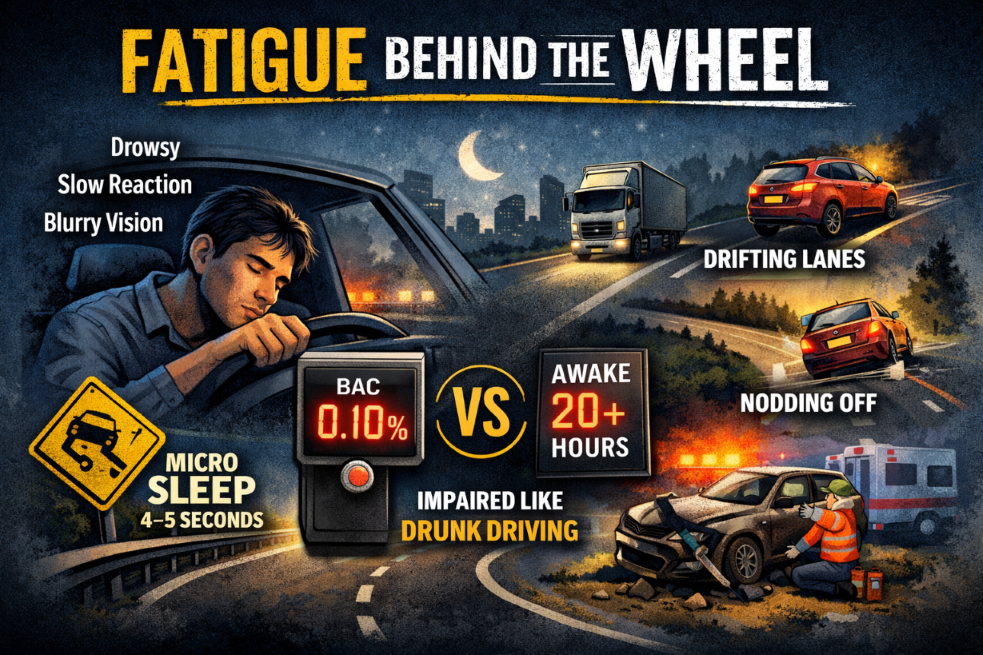
Fatigue Behind the Wheel: The Hidden Impairment
We Still Don’t Treat Like Alcohol
The message is clear: if you’re impaired, you don’t drive.
Research comparing sleep deprivation to alcohol impairment shows something uncomfortable. After about 20 hours awake, a person’s functional performance can drop to a level comparable to high BAC impairment. In other words, staying awake too long can make you “drive impaired” even if you
That comparison matters because fatigue is harder to “see” than alcohol. A tired driver may look normal, sound normal, and still be operating with slowed reaction time, reduced attention, and poor decision-making.
Why fatigue is so dangerous on the road
Fatigue doesn’t just make you feel sleepy. It can cause:
- Slower reaction time: braking, steering corrections, hazard recognition all take longer.
- Reduced vigilance: you miss signals, signs, pedestrians, and changing traffic conditions.
- Poor judgment and risk-taking: some people take shortcuts and accept higher risk when tired.
- Communication difficulty: tired people can struggle to find words or think clearly.
- Microsleeps: brief “naps” of 4–5 seconds that you may not even remember. At highway speed, that is enough time to travel roughly the length of a football field without real control.
The scariest part: fatigue builds up. Sleep debt is cumulative, so performance can keep declining over multiple days when rest is inadequate.
Who is most at risk
Fatigue-related driving risk increases sharply for people who:
- Work night shifts or rotating shifts (many shift workers stay awake 24 hours on the first night shift).
- Work extended hours or multiple consecutive days with short rest periods.
- Drive long distances (especially monotonous routes).
- Have poor sleep quality due to stress, illness, caffeine timing, late-night screen use, or sleeping in noisy environments (camps, shared accommodation).
- Have untreated health conditions that reduce sleep quality (for example, sleep apnea).
Warning signs you should never ignore
If you feel even one of the signs below while driving, treat it as a serious warning that you could fall asleep unintentionally.
- Eyes closing or going out of focus by themselves
- Difficulty keeping your head up
- Repeated yawning
- Wandering or disconnected thoughts
- Not remembering the last few miles
- Drifting between lanes, tailgating, missing traffic signs
- Jerking the car back into the lane
- Nearly running off the road
What to do immediately if you feel sleepy while driving
Do not “push through”. Fatigue is not fixed by willpower, loud music, cold air, or opening a window.
Do this instead:
- Pull over safely at the next appropriate place (well-lit, safe area).
- Take a short nap (15–20 minutes is often practical).
- Hydrate and reassess before continuing.
- If symptoms return quickly, stop driving and arrange a change of driver or rest.
Practical prevention: before the trip
For drivers
- Sleep plan: aim for a full night of sleep before long drives or night shifts.
- Avoid long stretches without breaks: plan stops, rotate drivers when possible.
- Watch the “danger window”: fatigue risk rises late night and early morning, and also mid-afternoon.
- Be careful with caffeine: it can help temporarily, but it is not a substitute for sleep.
- Don’t rely on “microsleep luck”: if you have warning signs, your risk is already high.
For supervisors and employers (especially fleets, camps, O&G operations)
If your company already has strict controls for alcohol and drugs, fatigue should be managed with the same seriousness.
A simple fatigue management approach can include:
- Journey management: maximum driving hours, mandatory breaks, night driving controls.
- Shift design: avoid excessive consecutive shifts, ensure adequate rest after nights.
- Fitness-to-drive checks: quick pre-trip screening questions (sleep hours, symptoms).
- Reporting culture: no blame for stopping due to fatigue; encourage stop-work authority.
- Incident learning: treat fatigue as a credible contributing factor in investigations.
The bottom line
We already accept that an intoxicated person should not drive. Evidence suggests that extended wakefulness can impair performance to a level that society would not accept if it were alcohol related.
If you manage operations, transport, or shift work, the question is simple:
Would you allow a driver over the legal alcohol limit behind the wheel?
If not, it’s time to treat serious fatigue the same way.