Fire Prevention vs Fire Protection
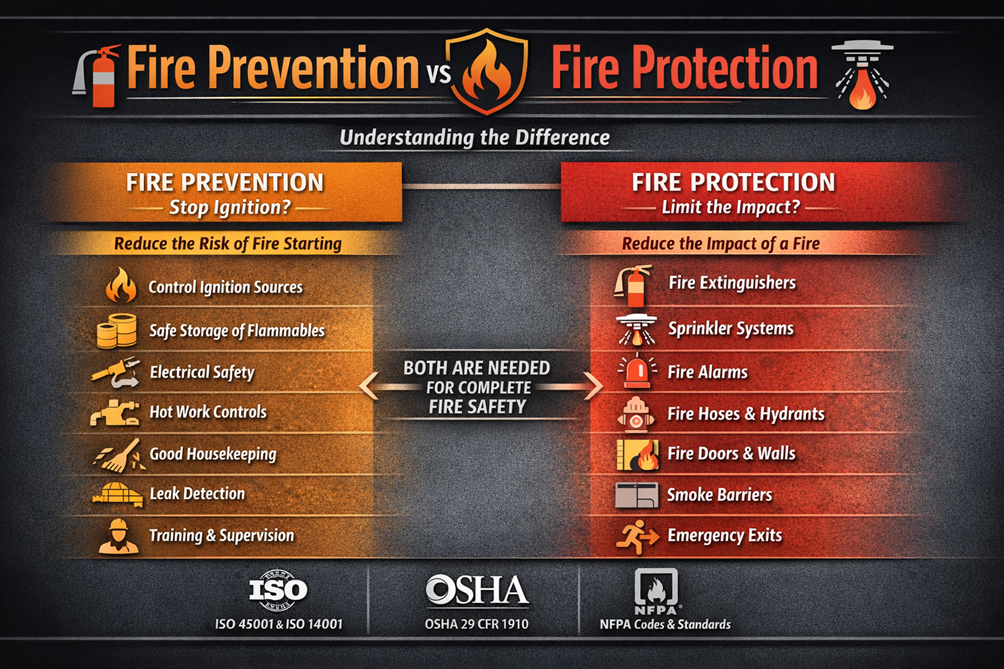
In many workplaces, the terms fire prevention and fire protection are used as if they mean the same thing. In reality, they are different parts of a complete fire safety system. Fire prevention is about stopping a fire from starting. Fire protection is about detecting, controlling, containing, and minimizing loss if a fire does occur. A professional fire safety program requires both. OSHA’s fire prevention requirements focus on identifying fire hazards, controlling ignition sources, and managing combustible materials, while OSHA and NFPA fire protection requirements address equipment and systems such as extinguishers, alarms, sprinklers, standpipes, and fixed suppression systems.
What is Fire Prevention?
Fire prevention includes all actions taken to avoid ignition and stop a fire from starting in the first place. This includes controlling heat sources, managing combustible materials, maintaining electrical systems, enforcing hot work controls, improving housekeeping, and ensuring safe storage of flammable substances. OSHA 29 CFR 1910.39 specifically requires employers to identify major fire hazards, list proper handling and storage procedures for hazardous materials, control ignition sources, manage combustible waste, and maintain heat-producing equipment.
From a management system perspective, fire prevention aligns strongly with ISO 45001:2018, especially where the organization is required to identify hazards, assess risks, establish operational controls, provide competence and awareness, and take corrective action. The most relevant ISO 45001 clauses for fire prevention are
- 6.1.2 Hazard identification,
- 7.2 Competence,
- 7.3 Awareness,
- 8.1 Operational planning and control,
- 9.1 Monitoring and measurement, and
- 10.2 Incident, nonconformity and corrective action.
ISO describes 45001 as a framework for managing OH&S risks and improving worker safety.
Typical fire prevention measures
- Good housekeeping
- Control of hot work
- Inspection of electrical systems
- Safe storage of flammable liquids
- Smoking controls
- Removal of combustible waste
- Leak prevention
- Gas testing where required
- Worker training and supervision
What is Fire Protection?
Fire protection includes the systems, equipment, and structural features used to protect people, property, and operations when a fire occurs. The purpose is not to stop ignition, but to detect fire early, warn occupants, control spread, support evacuation, and assist firefighting. OSHA’s fire protection subpart covers portable extinguishers, standpipe and hose systems, automatic sprinklers, fixed extinguishing systems, fire detection systems, and employee alarm systems. NFPA also identifies alarms, sprinklers, pumps, and water-based fire protection systems as core fire protection measures.
Fire protection is generally divided into two categories:
Active fire protection
These are systems that operate automatically or by human action, such as:
- Fire extinguishers
- Hose reels
- Hydrants
- Sprinkler systems
- Smoke detectors
- Heat detectors
- Fire alarm systems
- Foam systems
- Gaseous suppression systems
- Fire pumps
Passive fire protection
These are built-in features that slow fire and smoke spread, such as:
- Fire-rated walls
- Fire doors
- Compartmentation
- Fire stopping
- Protected escape routes
- Structural fire resistance
NFPA’s codes and standards list includes key technical documents such as NFPA 10 for portable fire extinguishers, NFPA 13 for sprinkler systems, NFPA 25 for inspection, testing, and maintenance of water-based systems, NFPA 72 for fire alarm and signaling systems, NFPA 30 for flammable and combustible liquids, and NFPA 101 for life safety.
The Key Difference
The simplest difference is this:
- Fire prevention reduces the chance of fire starting.
- Fire protection reduces the impact if fire starts.
For example, controlling welding sparks through a permit system is fire prevention. Installing extinguishers and alarms is fire protection. Removing oily rags and combustible waste is fire prevention. Installing sprinklers and fire-rated doors is fire protection. OSHA’s structure clearly separates these areas by addressing fire prevention plans in one section and fire protection equipment and systems in another.
Why Both are Necessary
An organization that focuses only on fire prevention may still suffer severe loss if a fire starts unexpectedly. An organization that focuses only on fire protection may remain exposed to frequent ignition risks because daily controls are weak. That is why both elements are essential.
Prevention reduces likelihood. Protection reduces severity. This is fully consistent with the logic of risk management under ISO 45001 and broader safety practice. ISO provides the management framework. OSHA gives workplace requirements. NFPA provides technical design and maintenance standards. Together, they support a complete fire safety approach.
Practical Examples
In an office
Fire prevention
- Avoid overloaded sockets
- Inspect damaged cables
- Control paper waste
- Enforce no smoking
Fire protection
- Smoke alarms
- Portable extinguishers
- Emergency lighting
- Marked escape routes
In a warehouse
Fire prevention
- Proper stacking
- Segregation of flammables
- Housekeeping
- Battery charging controls
Fire protection
- Hydrants
- Hose reels
- Sprinkler systems
- Fire alarm systems
In construction
Fire prevention
- Hot work permit system
- LPG cylinder control
- Temporary electrical safety
- Debris removal
Fire protection
- Readily available extinguishers
- Emergency procedures
- Alarm or warning system
- Assembly points
In oil and gas operations
Fire prevention
- Gas testing
- Leak control
- Ignition source control
- Bonding and grounding
- Permit-to-work and isolation systems
Fire protection
- Foam systems
- Hydrants and monitors
- Fire and gas detection
- Fixed suppression systems
- Passive fireproofing of critical structures
Role of ISO, OSHA, and NFPA
ISO
ISO standards are not fire engineering codes, but they help organizations manage fire-related risks systematically. ISO 45001 is the strongest fit for occupational fire risk management, while ISO 14001 becomes relevant where fire may cause environmental damage such as smoke emissions, contaminated runoff, or hazardous release. ISO 9001 supports consistent processes, maintenance controls, competence, and documented information.
OSHA
OSHA provides practical workplace requirements, especially:
- 29 CFR 1910.39 Fire Prevention Plans
- 29 CFR 1910.157 Portable Fire Extinguishers
- 29 CFR 1910 Subpart L Fire Protection
- 29 CFR 1926.150 Fire protection and prevention in construction
NFPA
NFPA provides the technical benchmark for fire systems, life safety design, and maintenance. It is especially important where organizations need guidance on extinguishers, alarm systems, sprinklers, flammable liquid storage, and inspection and testing of fire systems.
Conclusion
Fire prevention and fire protection are not the same. Fire prevention is concerned with stopping ignition. Fire protection is concerned with reducing harm once ignition occurs. One is proactive. The other is defensive. One lowers the chance of fire. The other limits the consequences.
A strong fire safety program should combine:
- ISO for management system control
- OSHA for workplace requirements
- NFPA for technical fire protection standards
That is the professional approach to fire safety in any workplace, whether office, warehouse, hospital, construction site, or industrial facility.
Suggested References
- ISO 45001:2018 Occupational health and safety management systems.
- ISO 14001:2015 Environmental management systems.
- OSHA 29 CFR 1910.39 Fire Prevention Plans.
- OSHA 29 CFR 1910 Subpart L Fire Protection.
- OSHA 29 CFR 1910.157 Portable Fire Extinguishers.
- NFPA 10, 13, 25, 30, 72, and 101.