
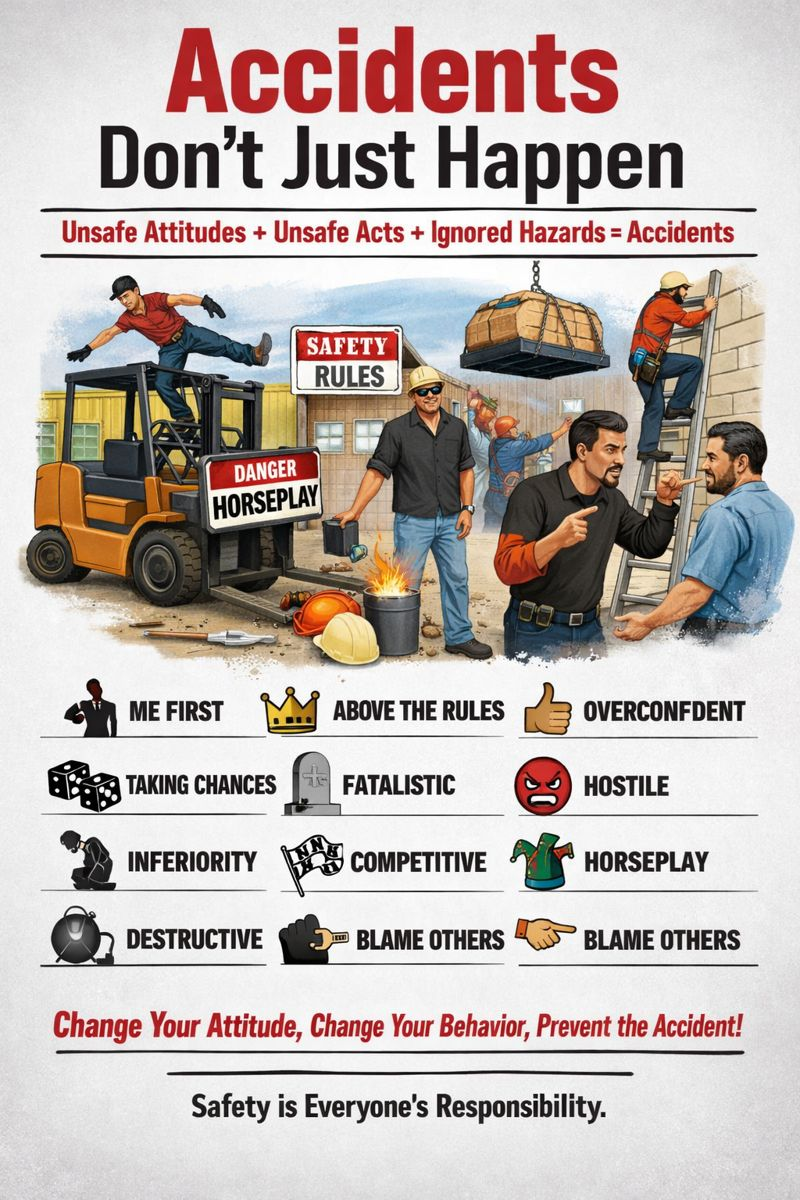
Accidents Don’t Just Happen
They are the end result of unsafe attitudes, unsafe acts, and unmanaged hazards.
Most accidents occur because:
- Safety rules are ignored.
- Risks are underestimated.
- Individuals fail to recognize how their attitudes influence their behavior.
Taking responsibility starts with self-reflection. The following attitudes are commonly linked to incidents and near-misses.
Selfishness – “Me first” attitude
Explanation:
Disregard for the safety, comfort, or rights of others.
- Example: Blocking emergency exits or removing machine guards to work faster.
- Root Cause: Poor safety culture, lack of empathy, production pressure.
- Solution:
- Reinforce teamwork and shared responsibility.
- Emphasize that one unsafe act can harm many.
Self-Importance – “Rules don’t apply to me”
Explanation:
Believing personal status, experience, or seniority places one above safety rules.
- Example: Supervisor bypassing PTW requirements.
- Root Cause: Authority bias, weak leadership accountability.
- Solution:
- Equal rule enforcement at all levels.
- Leadership by example.
Overconfidence – “I know what I’m doing”
Explanation:
Underestimating risks due to experience or skill.
- Example: Working at height without fall protection because it was done many times before.
- Root Cause: Familiarity breeding complacency.
- Solution:
- Regular refresher training.
- Stop-Work Authority reinforcement.
Chance-Taking – “It won’t happen to me”
Explanation:
Deliberately taking risks in belief of luck or immunity.
- Example: Standing under suspended loads.
- Root Cause: Risk normalization, poor hazard perception.
- Solution:
- Highlight real incident case studies.
- Reinforce hierarchy of controls.
Fatalistic Attitude – “If it’s destined, it will happen”
Explanation:
Belief that outcomes are beyond personal control.
- Example: Ignoring PPE because “death is written already.”
- Root Cause: Cultural beliefs, lack of safety awareness.
- Solution:
- Education on risk control effectiveness.
- Emphasize personal accountability.
Hostility – Persistent anger or aggression
Explanation:
Underlying frustration or anger leading to impulsive actions.
- Example: Aggressive driving at site.
- Root Cause: Stress, workload, unresolved conflicts.
- Solution:
- Stress management programs.
- Promote respectful workplace behavior.
Inferiority / Defensiveness – “I won’t be pushed around”
Explanation:
Reacting dangerously to perceived challenges or authority.
- Example: Refusing safety instruction to save face.
- Root Cause: Low self-esteem, fear of embarrassment.
- Solution:
- Supportive supervision.
- Encourage open communication.
Excessive Competitiveness – “Getting ahead at any cost”
Explanation:
Prioritizing speed or output over safety.
- Example: Skipping inspections to finish job earlier.
- Root Cause: Productivity-only performance metrics.
- Solution:
- Balance KPIs with safety indicators.
- Reward safe behavior.
Unconscious Self-Destruction
Explanation:
Risk-taking rooted in deeper psychological issues.
- Example: Repeated exposure to known hazards without concern.
- Root Cause: Mental health concerns, fatigue, burnout.
- Solution:
- Fitness-for-work systems.
- Access to counseling and fatigue management.
Horseplay – Showing off
Explanation:
Unsafe behavior for amusement or attention.
- Example: Playing with tools or machinery.
- Root Cause: Immaturity, poor supervision.
- Solution:
- Zero-tolerance policy.
- Behavioral safety observation programs.
Pleasure in Destruction
Explanation:
Deriving satisfaction from damaging property or systems.
- Example: Deliberate misuse of equipment.
- Root Cause: Behavioral or psychological maladjustment.
- Solution:
- Strong disciplinary action.
- Employee engagement and support.
Transfer of Guilt – Blaming others
Explanation:
Creating situations where responsibility is shifted.
- Example: Ignoring procedures expecting blame to fall elsewhere.
- Root Cause: Fear of accountability, weak incident culture.
- Solution:
- Just Culture approach.
- Clear role definitions and responsibility matrices.
“My safety is not a core value”
Explanation:
Lack of personal belief in the importance of safety.
- Example: Consistent PPE non-compliance.
- Root Cause: Poor safety leadership, inadequate induction.
- Solution:
- Values-based safety training.
- Continuous reinforcement by leaders.
Key Message for Workforce
Accidents are preventable.
They occur when:
- Unsafe attitudes influence decisions.
- Unsafe acts bypass controls.
- Hazards are ignored or tolerated.
Conclusion
Accidents do not occur by chance. They are predictable outcomes of human attitudes and behaviors interacting with hazards. By identifying and correcting unsafe attitudes, individuals can actively prevent incidents before they occur. A strong safety culture begins when every person accepts that their safety and the safety of others is a personal and shared responsibility.
Change the attitude → Change the behavior → Prevent the accident